In 2026, manufacturers are tightening warranty targets and pushing higher equipment uptime — while field conditions keep getting harsher. Vibration levels are higher on EV platforms and industrial machinery running at increased duty cycles. Washdown frequencies are greater in food processing and pharmaceutical facilities. Salt spray and UV exposure are more demanding on outdoor equipment that is expected to last longer between service intervals. In this environment, the rubber washer has moved from a background BOM item to a component that directly affects corrosion warranty costs, re-torque labor, and field complaint rates — and the teams that understand its full function are getting measurably better outcomes than those that treat it as a simple sealing disc.
The full function of a rubber washer in a metal fastener assembly is threefold: it seals the joint against fluid ingress, it damps the micro-vibration that loosens fasteners over time, and it acts as a protective barrier between the metal hardware and the coated or finished surface beneath it. Working with a capable rubber washer company that controls material selection, hardness, and dimensional tolerances at scale is the difference between a washer that delivers all three functions consistently and one that compresses out, cracks, or hardens before the warranty period ends.
Most engineers specify a rubber washer for sealing. The vibration damping and surface protection functions are often discovered after the fact — when a warranty claim arrives showing rust initiating at a fastener location, or when a field service report documents a fastener that has backed out of a joint that was correctly torqued at assembly.
The failure sequence that anti-vibration rubber washers prevent is not dramatic — it is incremental, and it is exactly the kind of failure that is difficult to trace back to its root cause without understanding the mechanics of the joint.
Vibration in the assembly generates micro-movement at the fastener interface. The metal washer or bolt head moves fractionally against the coated surface beneath it with each vibration cycle. Over thousands of cycles, this micro-movement abrades the coating at the contact point — a process called fretting. Once the coating is breached, the bare metal beneath is exposed to moisture, oxygen, and any corrosive media present in the environment. Corrosion initiates at the breach point and spreads under the coating, producing the rust blistering and paint lifting that generates cosmetic warranty claims and, in structural applications, loss of clamp force.
Simultaneously, the micro-movement at the joint reduces the effective clamp force of the fastener. The vibration-induced loosening is gradual — the fastener does not back out suddenly — but the reduction in clamp force reduces the joint's resistance to further movement, accelerating both the fretting damage and the loosening rate. The result is a fastener that requires re-torquing at service intervals, or that backs out entirely between service intervals and generates a field failure.
A correctly specified rubber washer interrupts this failure chain at the first step. The elastomer layer absorbs the micro-vibration before it reaches the coating, eliminating the fretting mechanism. The rubber's compliance distributes the contact pressure over a larger area, reducing the peak stress at the coating surface. And the rubber's sealing function prevents moisture from reaching the coating breach even if minor surface damage does occur.
For procurement and engineering teams managing warranty cost targets in 2026, the rubber washer's vibration damping and surface protection functions translate directly into measurable KPIs: reduced corrosion-related warranty claims, reduced re-torque labor at service intervals, and reduced field complaint rates from vibration-induced loosening. These are not marginal improvements — in high-vibration applications such as industrial machinery, automotive body panels, and outdoor electrical enclosures, the cost of a single corrosion warranty claim typically exceeds the cost of the rubber washers in the entire assembly by a factor of ten or more.
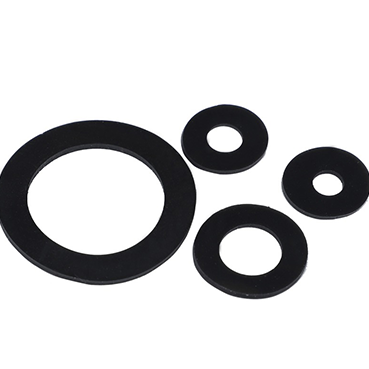
Understanding the working principle of a rubber flat washer in a fastener assembly clarifies why material selection, hardness, and dimensional specification matter — and why a washer that is correct for one application may be incorrect for another.
When a metal bolt is tightened against a coated sheet metal panel, the contact area between the bolt head or metal washer and the panel surface is limited to the area of the washer face. The clamping force is concentrated in this area, producing a contact pressure that can exceed the compressive strength of the coating at the contact perimeter — particularly on thin coatings or soft substrates. A rubber flat washer between the metal hardware and the coated surface distributes the contact pressure over the full washer face area, reducing the peak stress at the coating surface and preventing the coating compression damage that initiates corrosion.
The elastomer layer in a rubber washer absorbs vibrational energy through internal damping — the molecular friction within the rubber network that converts mechanical energy to heat. When vibration is transmitted through the fastener into the joint, the rubber washer deforms elastically with each vibration cycle, absorbing a portion of the energy before it reaches the coating surface. The damping coefficient of the rubber — which depends on the compound and hardness — determines how much energy is absorbed per cycle. A softer compound absorbs more energy per cycle but may compress further under clamp load; a harder compound maintains its thickness better under clamp load but absorbs less energy per cycle. The correct hardness selection balances these two requirements for the specific application.
The rubber washer's contact with both the metal hardware above it and the coated surface below it creates a sealed interface that prevents moisture, cleaning fluids, and corrosive media from reaching the coating beneath the fastener. This sealing function is most important in outdoor applications, washdown environments, and any application where the fastener penetrates a surface that is exposed to liquid on one side. The sealing effectiveness depends on the rubber's compression set resistance — its ability to maintain its compressed thickness over time without permanently deforming — which is determined by the compound selection and the operating temperature.
Specifying a rubber washer correctly requires defining the compound, hardness, temperature range, media exposure, and dimensional requirements before the order is placed. The following checklist covers the parameters that determine whether the washer delivers its sealing, damping, and surface protection functions throughout its service life.
| Compound | Key Properties | Working Temperature | Hardness (Shore A) | Best Application |
|---|---|---|---|---|
| NBR (Nitrile) | Best cost-effective oil resistance; strength increases with acrylonitrile content; poor ozone resistance | -30°C to 120°C | 40–100 | Automotive, machinery with oil splash, fuel system fasteners |
| EPDM | Best weathering and ozone resistance; good steam, acid, and alkali resistance; poor oil resistance | -50°C to 150°C | 40–90 | Outdoor hardware, construction, HVAC, washdown environments |
| CR (Neoprene) | Flame retardant; good weathering and ozone resistance; moderate oil resistance | -40°C to 120°C | 40–95 | Marine, chemical processing, moderate oil and weathering exposure |
| FKM (Fluorocarbon) | Best high-temperature and chemical resistance; low elasticity; higher cost | -30°C to 200°C | 50–90 | High-temperature industrial, aggressive chemical environments |
| VMQ (Silicone) | Widest temperature range; excellent electrical insulation; low strength; poor oil resistance | -100°C to 250°C | 20–80 | Extreme temperature, food processing, electrical insulation applications |
| NR (Natural Rubber) | High elasticity; excellent tensile strength and abrasion resistance; poor oil and ozone resistance | -60°C to 80°C | 40–90 | General industrial, low-temperature, non-oil environments |
Oil or fuel contact: NBR is the standard starting point for cost-effective oil resistance. FKM is the correct choice when the oil exposure is combined with high temperature or aggressive chemical content.
Outdoor ozone and weathering exposure: EPDM is the standard starting point for outdoor applications. CR provides moderate oil resistance in addition to weathering resistance for applications with combined exposure.
High temperature above 150°C: FKM covers up to 200°C; VMQ covers up to 250°C for extreme temperature applications.
Electrical insulation or specialty requirements: VMQ provides excellent electrical insulation for electronics enclosure fasteners. Conductive ESD variants and EMI shielding variants are available for applications where static dissipation or electromagnetic shielding is required at the fastener location.
Define the inner diameter to match the fastener shank diameter with the correct clearance. Define the outer diameter to match the contact area required for load distribution and sealing. Define the thickness to achieve the target compression under the specified clamp load — thicker washers provide more damping capacity but require longer fasteners to maintain the same clamp force. Define the compression set target — the maximum permanent deformation allowed after extended compression — to ensure the washer maintains its sealing and damping function over the service life. Specify whether a metal-insert or bonded washer style is required for applications where the washer must resist pull-through under high clamp loads or where the washer must be retained on the fastener during assembly.
SRRP produces rubber washers using pressure rubber molding for precision-dimensioned components and rubber die-cutting for flat washer profiles where tight dimensional tolerances are required at high volume. The production method affects the dimensional consistency, the surface finish, and the minimum order quantity — confirm the production method with the supplier when placing the initial order to ensure the lead time and cost structure match the program requirements.
In industrial machinery — pumps, compressors, conveyors, and process equipment — vibration is continuous and the fastener count is high. A single re-torque event on a large machine requires a maintenance technician to access and re-torque dozens or hundreds of fasteners, at a labor cost that accumulates quickly across a fleet. Anti-vibration rubber washers at the fastener locations reduce the vibration transfer that causes loosening, extending the interval between re-torque events and reducing the labor cost of the maintenance program. In washdown environments — food processing, pharmaceutical, and chemical processing facilities — the sealing function of the rubber washer prevents moisture ingress at the fastener locations, reducing the corrosion that generates equipment downtime and replacement costs.
In automotive body panel assemblies, the rubber washer's surface protection function is most visible in its effect on corrosion warranty claims. Metal fasteners tightened directly against painted panels abrade the coating at the contact perimeter during assembly and during service vibration, creating the coating breach points that initiate rust. Rubber flat washers between the metal hardware and the painted surface prevent this abrasion, protecting the coating integrity and reducing the corrosion warranty claims that are among the most expensive in the automotive warranty portfolio. At mounting points for brackets, trim panels, and underbody components, the rubber washer's damping function reduces the NVH contribution of the fastener joint, improving the cabin noise performance without requiring changes to the surrounding structure.
In electronics enclosures and electrical distribution equipment, the rubber washer serves three functions simultaneously: it seals the fastener penetration against moisture ingress that could cause short circuits or corrosion of electrical contacts, it provides electrical insulation between the metal fastener and the enclosure surface where isolation is required, and it protects the enclosure coating from the abrasion damage that initiates corrosion in outdoor and industrial environments. VMQ silicone washers are the standard choice for applications requiring both wide temperature range and electrical insulation. Conductive ESD washers are available for applications where static dissipation at the fastener location is required.
In outdoor construction hardware — roofing fasteners, facade cladding, and structural connections — the rubber washer's sealing and surface protection functions directly affect the service life of the assembly. A roofing fastener without a rubber washer creates a potential water ingress point at every penetration. A facade cladding fastener without a rubber washer creates a coating breach point at every contact location. In both cases, the cost of the rubber washer is a fraction of the cost of the water damage or corrosion repair that the washer prevents.
Step one: define the primary problem the washer must solve. If the primary problem is leakage at the fastener location, the sealing function is the priority and the compound selection should focus on compression set resistance and media compatibility. If the primary problem is coating damage and rust initiation at fastener locations, the surface protection function is the priority and the compound selection should focus on hardness and load distribution. If the primary problem is fastener loosening from vibration, the damping function is the priority and the compound selection should focus on damping coefficient and compression set resistance.
Step two: identify the operating environment. Define the temperature range — both the continuous operating temperature and the peak temperature during startup or process excursions. Identify the media exposure — oil, fuel, cleaning chemicals, outdoor ozone, UV, or washdown fluids. Identify the vibration severity — whether the vibration is continuous, intermittent, or shock-type — and the frequency range if known.
Step three: select the compound family and hardness range. Use the compound selection table to identify the elastomer that matches the temperature range and media exposure. Select the hardness range based on the clamp load and the required compression — softer for higher damping and better load distribution, harder for better clamp load retention and lower compression set.
Step four: confirm the dimensional requirements. Define the ID, OD, and thickness based on the fastener size, the contact area required, and the stack height available. Confirm the compression target — the percentage compression under the specified clamp load — and verify that the selected hardness and thickness will achieve the target compression without bottoming out or extruding beyond the washer OD.
Step five: prototype and validate. Assemble a sample joint with the specified washer and apply the target clamp load. Measure the compressed thickness and verify that the clamp load is within the target range. Subject the assembly to the expected vibration and temperature cycling, and inspect the coating surface beneath the washer after the test to confirm that the surface protection function is performing as expected.
| Cost Item | Without Rubber Washer | With Correctly Specified Rubber Washer |
|---|---|---|
| Corrosion warranty claims from coating damage | Higher — metal hardware abrades coating at contact perimeter | Lower — rubber barrier prevents coating abrasion |
| Re-torque labor at service intervals | Higher — vibration loosening requires periodic re-torque | Lower — damping reduces loosening rate |
| Coating touch-up and repaint cost | Higher — rust initiation at fastener locations requires local repair | Lower — coating integrity maintained under fastener |
| Water ingress and related damage | Higher in unsealed joints | Lower — rubber sealing function prevents ingress |
| Washer replacement cost | Not applicable | Low — rubber washer cost is typically $0.01 to $0.50 per unit depending on size and compound |
The ROI calculation for a rubber washer upgrade is straightforward in applications where the failure cost is known. A single corrosion warranty claim on an automotive body panel typically costs $300 to $800 in parts and labor. If the rubber washer upgrade costs $0.10 per fastener and there are 20 fastener locations on the panel, the total washer cost is $2.00 per vehicle. The washer upgrade pays back on the first warranty claim it prevents — and continues to pay back on every subsequent claim that does not occur.
A rubber washer is not only a sealing component. In metal fastener assemblies subject to vibration, outdoor exposure, or washdown conditions, it is a low-cost barrier that prevents the coating damage that initiates corrosion, damps the micro-vibration that loosens fasteners over time, and distributes the clamp load that would otherwise concentrate at the coating surface. These three functions — sealing, damping, and surface protection — are delivered simultaneously by a single BOM item that costs a fraction of the warranty and service events it prevents.
The key to capturing this value is correct specification: compound matched to the temperature range and media exposure, hardness matched to the clamp load and damping requirement, and dimensions matched to the fastener size and stack height. Working with an experienced rubber washer company that controls material selection and dimensional tolerances at scale ensures that the washer delivers its specified performance consistently across the production volume.
Visit the rubber washer product page to review the full range, then submit the following details to receive a matched specification and quotation:
| Parameter | What to Provide |
|---|---|
| Work condition | Vibration level, indoor or outdoor, washdown exposure, oil or chemical contact, temperature range |
| Quantity | Prototype quantity and annual volume |
| Size and spec | ID, OD, thickness, tolerance requirements, bonded or metal-insert requirement if applicable |
| Target metrics | Sealing requirement (IP rating or leak specification), clamp load retention goal, corrosion or warranty target |
| Current problem | Coating scratched and rusting at fastener locations, fasteners loosening, noise or rattle, leakage, premature washer cracking |
1. What is a rubber washer?
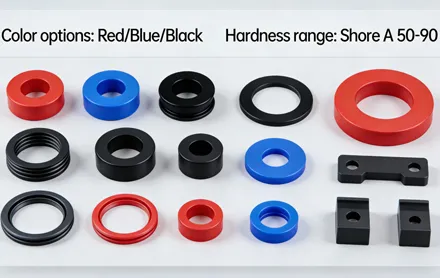
A rubber washer is a flat, disc-shaped elastomer component placed between a metal fastener and the surface it contacts in an assembly. Its primary functions are sealing the joint against fluid ingress, cushioning the contact between the metal hardware and the surface beneath it to prevent coating damage, and damping the micro-vibration that would otherwise loosen the fastener over time. Rubber washers are available in a range of elastomer compounds — NBR, EPDM, CR, FKM, VMQ, and NR — each with different temperature ranges, media resistance properties, and hardness ranges, allowing the washer to be matched to the specific operating environment and performance requirements of the application. Sunrise Rubber supports customization in size, thickness, and material choice, and produces rubber washers using pressure rubber molding and rubber die-cutting to match the dimensional and volume requirements of each program.
2. How does a rubber washer compare to a metal washer or gasket tape?
A metal washer provides excellent load distribution and does not compress under clamp load, but it does not seal the joint, does not damp vibration, and does not protect the coating beneath it from abrasion — the metal-to-coating contact under a metal washer is the most common source of coating damage and rust initiation at fastener locations. Gasket tape and sheet gasket materials provide good sealing performance over large contact areas, but they are less consistent for fastener-by-fastener joints where the contact area is small and the compression must be controlled precisely to maintain the clamp load. A rubber washer combines localized sealing, vibration damping, and surface protection in a single component that is consistent in dimension and compression behavior across the production volume — making it the most practical solution for fastener joints where all three functions are required.
3. Do anti-vibration rubber washers actually save money?
Yes, in applications where the cost of the failure they prevent is greater than the cost of the washer — which is the case in the majority of industrial, automotive, and outdoor hardware applications. The washer cost is typically $0.01 to $0.50 per unit depending on size and compound. The cost of a single corrosion warranty claim, a re-torque service event, or a water ingress failure is typically $100 to $800 or more depending on the application and the market. The payback calculation is straightforward: if the washer prevents one warranty claim per hundred assemblies, and the warranty claim costs $300, the washer pays back at a washer cost of up to $3.00 per unit — which is well above the actual cost of the washer in most applications.
4. Do we need to modify our parts to add rubber washers?
In most cases, no modification is required. If the assembly already uses a metal washer at the fastener location, the rubber washer can replace it or be added to the stack without changing the surrounding parts — provided the fastener length is sufficient to accommodate the additional stack height of the rubber washer under compression. Confirm the compressed thickness of the rubber washer at the target clamp load, and verify that the fastener length provides adequate thread engagement after accounting for the compressed washer thickness. If the assembly does not currently use a washer, confirm that there is a flat contact area at the fastener location that is large enough to accommodate the rubber washer's OD without interfering with adjacent features.
5. What parameters should I provide to rubber washer manufacturers for correct selection?
Provide the operating environment including the temperature range, oil and fuel exposure, outdoor ozone and UV exposure, washdown fluids, and any chemical media that the washer will contact. Provide the required hardness range or compression behavior — whether the washer needs to be soft for maximum damping or harder for better clamp load retention. Provide the dimensional requirements including ID, OD, and thickness, along with the tolerance requirements for each dimension. Provide the sealing requirement if applicable — whether an IP rating or a specific leak test specification must be met. Provide the vibration severity and frequency range if the damping function is the primary requirement. And provide the current failure mode — whether that is coating damage and rust at fastener locations, fastener loosening, noise or rattle, leakage, or premature washer cracking — because the failure mode identifies the specific aspect of the current specification that needs to change.