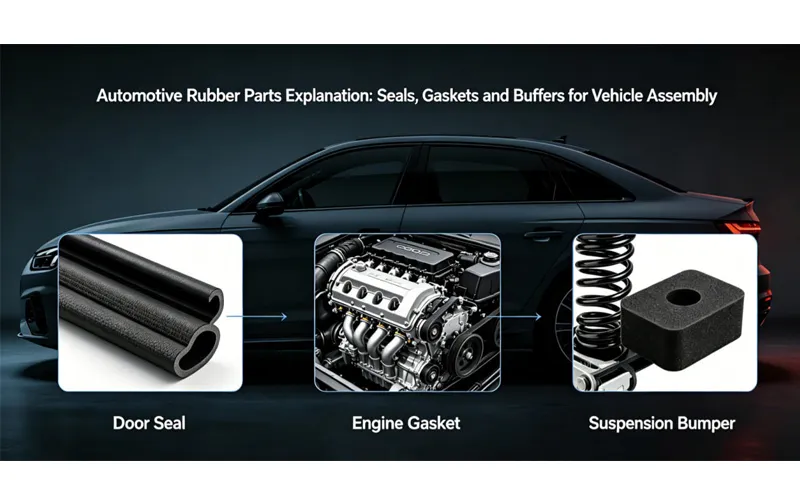
Automotive sealing parts are the "protective barrier" of vehicles, responsible for waterproofing, dustproofing, sound insulation, and shock absorption, directly affecting the comfort, safety, and service life of the vehicle. In recent years, HDPE (High-Density Polyethylene) & rubber composite materials have gradually become the preferred choice for automotive manufacturers when selecting sealing part materials, replacing traditional single rubber or plastic materials in many scenarios. What are the unique advantages of this composite material that make it widely used in automotive sealing parts? Let’s explore in detail.
First, let’s clarify the core characteristics of HDPE and rubber materials separately. HDPE is a high-crystallinity thermoplastic polymer with excellent mechanical properties, including high rigidity, wear resistance, and chemical corrosion resistance. It is not easy to deform under high and low temperatures, and has good processing fluidity, which can be easily formed into various complex shapes. Rubber, on the other hand, has outstanding elasticity, flexibility, and sealing performance, which can fit closely with the uneven surfaces of automotive parts, effectively blocking water, dust, and noise from entering the vehicle interior.
The combination of HDPE and rubber forms a composite material that integrates the advantages of both, making up for the defects of a single material. For automotive sealing parts, this composite material has three core advantages that are irreplaceable.
First, it has excellent dimensional stability and durability. Traditional rubber sealing parts are prone to aging, hardening, or deformation after long-term exposure to high temperatures (such as engine compartment heat), low temperatures (such as cold winter environments), and external friction. HDPE, as the skeleton of the composite material, provides strong support for the rubber, effectively inhibiting the shrinkage and deformation of the rubber, ensuring that the sealing parts maintain their original shape and size for a long time. This means that the sealing parts can still maintain good sealing performance after the vehicle has been used for several years, reducing the frequency of replacement and maintenance, and lowering the after-sales cost for automotive manufacturers and users.
Second, it achieves a perfect balance between sealing performance and wear resistance. Automotive sealing parts, such as door seals, window seals, and engine compartment seals, need to withstand frequent friction (such as opening and closing doors and windows) and external impact. Single rubber materials have good sealing performance but poor wear resistance, and are easy to wear and tear after long-term use; single HDPE materials have good wear resistance but lack elasticity, making it difficult to achieve tight sealing. The HDPE & rubber composite material solves this problem: the rubber layer is in direct contact with the vehicle body, ensuring tight fitting and sealing, while the HDPE layer is used as the structural layer, enhancing the wear resistance and impact resistance of the sealing part, extending the service life of the product.
Third, it has excellent cost-effectiveness and environmental friendliness. Compared with other high-performance composite materials, HDPE & rubber composite materials have lower raw material costs and simpler production processes, which can help automotive manufacturers reduce production costs under the premise of ensuring product quality. At the same time, both HDPE and rubber materials can be recycled and reused, in line with the global trend of automotive industry environmental protection and energy conservation. For overseas automotive manufacturers and procurement companies that pay attention to environmental protection compliance, this is an important advantage.
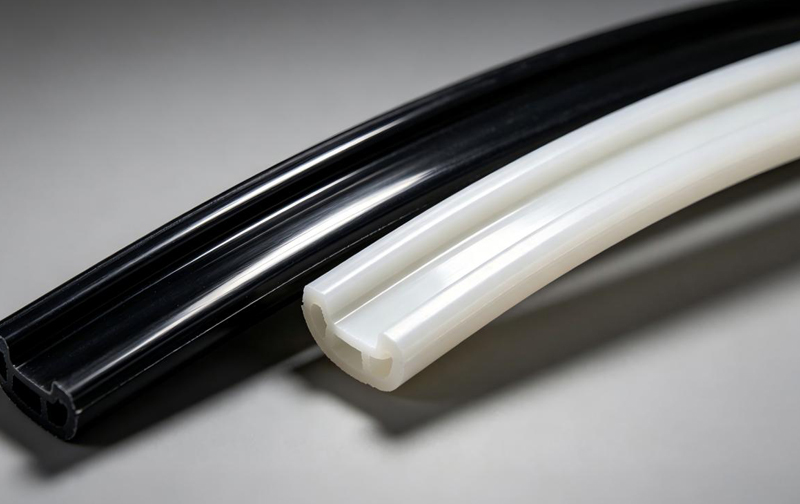
In practical applications, HDPE & rubber composite materials are widely used in various automotive sealing parts, such as door weather strips, window seals, trunk seals, engine compartment seals, and sunroof seals. For example, in door weather strips, the HDPE skeleton ensures the shape of the strip, preventing it from being deformed by extrusion when the door is closed, while the rubber layer closely fits the door and the vehicle body, achieving excellent sound insulation and waterproofing effects. In engine compartment seals, the composite material’s high-temperature resistance and corrosion resistance can effectively resist the erosion of engine exhaust gas and high temperature, ensuring long-term stable operation.
As a professional custom rubber products manufacturer with its own factory, we have rich experience in the research, development and production of HDPE & rubber composite material sealing parts. We can customize products of different specifications, sizes and performance according to the drawings and requirements of automotive customers, ensuring that the products fully meet the technical standards of the automotive industry and pass international certifications such as RoHS and REACH. Whether you are an automotive OEM, a parts supplier, or a procurement company, we can provide you with one-stop custom solutions, helping you reduce costs and improve product competitiveness.
If you are looking for high-quality HDPE & rubber composite automotive sealing parts, or want to know more about the application of this composite material in automotive parts, please contact us. Our professional team will provide you with detailed technical support and quotation services.