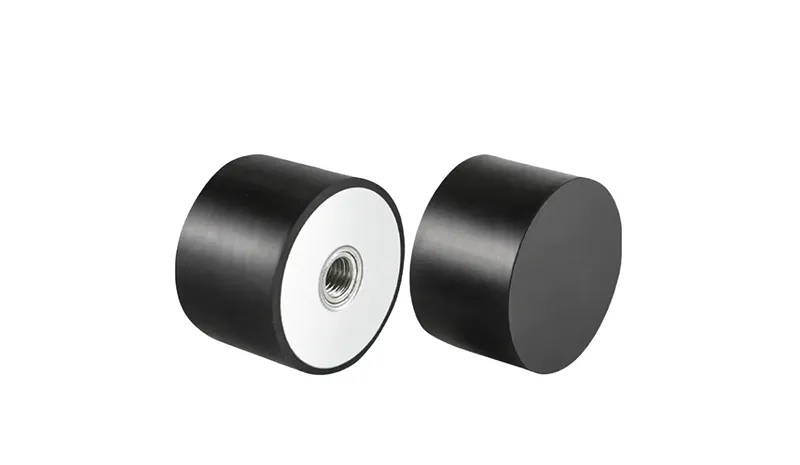
Cold resistance of rubber refers to its ability to retain elasticity and perform normally under specified low temperatures. At low temperatures, vulcanized rubber undergoes a sharp slowdown in relaxation processes, accompanied by increased hardness, modulus, and internal molecular friction, resulting in significantly reduced elasticity and impaired performance of rubber products—especially under dynamic conditions. When the temperature drops below the critical service temperature for elasticity, rubber hardens and shrinks, often causing seal leakage and failure.
The cold resistance of vulcanized rubber mainly depends on two fundamental polymer characteristics: glass transition and crystallization, both of which cause rubber to lose elasticity at low temperatures.
Choosing raw rubber with excellent cold resistance is critical. Cold resistance is primarily determined by rubber type:
Amorphous rubbers have low glass transition temperatures (Tg) and good cold resistance.
Crystalline rubbers require consideration of both Tg and crystallization behavior.
Improving molecular chain flexibility, reducing intermolecular forces and steric hindrance, and weakening the regularity of macromolecular chains all help enhance cold resistance. Blending is a common method to adjust cold resistance, such as SBR blended with BR, and NBR blended with NR, CO, or ECO.
The type of crosslink significantly affects cold resistance. For natural rubber (NR) using conventional sulfur vulcanization, increasing sulfur content up to 30 phr raises the shear modulus and Tg (by 20–30 °C). An optimized vulcanization system can lower Tg by about 7 °C compared to the conventional system.
NR and SBR vulcanized with DCP show the best cold resistance.
Thiuram vulcanization leads to slightly lower cold resistance.
Sulfur/sulfenamide accelerator systems yield the poorest cold resistance.
Reason: Conventional sulfur vulcanization forms polysulfide crosslinks, intramolecular crosslinks, and cyclization, restricting segmental mobility and raising Tg. Semi-efficient (SEV) or efficient vulcanization (EV) systems reduce polysulfides and favor mono‑ and disulfides, limiting the Tg increase. Peroxide and radiation vulcanization form short, strong C–C crosslinks and provide larger free volume, further lowering Tg and improving low-temperature flexibility.
Fillers affect cold resistance through the structure formed by filler–rubber interactions. Adding fillers hinders segmental rearrangement and increases rigidity, so fillers do not improve cold resistance. Higher rubber content and lower filler loading are beneficial for low-temperature performance.
Using a suitable plasticizer system is an effective way to improve cold resistance, as plasticizers lower Tg. Polar rubbers with poor cold resistance (e.g., NBR, CR) rely heavily on appropriate plasticizers.
Plasticizers enhance molecular flexibility, reduce intermolecular forces, and promote segmental movement. Polar rubbers should use plasticizers with similar polarity and solubility parameters. The type and dosage of plasticizers are critical to the low-temperature performance of rubber products.