In 2026, EV platforms are running higher pack voltages, tighter component packaging, and harsher duty cycles than any previous generation of electric vehicles. The warranty claims that result from these conditions increasingly trace back not to the high-technology components—the cells, the inverter, the thermal system—but to the interface points that nobody paid close attention to during design: the places where wiring passes through metal and plastic panels.
Harness chafing against a sharp panel edge. Water intrusion through an unsealed pass-through in an underbody splash zone. Vibration-driven insulation wear at a battery enclosure entry point. Each of these failure modes is preventable. Each of them costs more to repair after the vehicle reaches the customer than the component that would have prevented it costs to specify and source correctly.
A correctly specified rubber grommet at each cable pass-through point is one of the most cost-effective reliability investments in an EV harness system. Ordered as standardized bulk rubber grommets for production and service, they protect battery-system wiring by sealing, cushioning, and preventing the edge abrasion that creates expensive downstream failures.
The rubber grommet is a deceptively simple component that simultaneously addresses four distinct failure mechanisms at the cable pass-through interface.
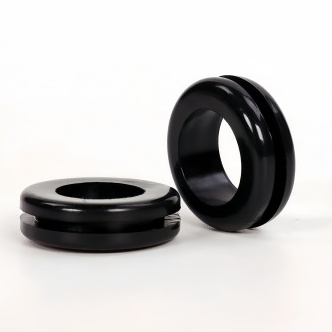
The primary function of any rubber grommet is to place an elastomer barrier between the cable insulation and the panel edge. Sheet metal pass-throughs—even well-finished ones—present a hard, potentially sharp boundary that contacts the cable whenever the harness moves. Over thousands of vibration cycles and thermal expansion events, this contact becomes abrasion. The elastomer lip of the grommet absorbs this contact and distributes it across a smooth, compliant surface rather than a rigid edge.
EV platforms generate vibration from road inputs, motor operation, and thermal expansion cycling of the battery pack. At pass-through points, this vibration produces micro-motion between the cable and the panel. A rubber grommet with appropriate durometer compliance absorbs this micro-motion rather than transmitting it to the cable insulation as a repetitive cutting or scraping force.
A grommet with a compressive fit around both the cable OD and the panel hole creates a path-of-least-resistance barrier against water and dust ingress. For battery enclosure pass-throughs in underbody locations, splash zones, and wash-down environments, this sealing function directly determines whether the enclosure's IP rating is maintained at the cable entry point—the point most commonly responsible for IP rating failures in field testing.
At a panel pass-through without a grommet, harness movement concentrates bending stress at the panel edge. A rubber grommet with a stepped internal bore or strain relief feature distributes this bending over a longer length of cable, reducing the stress concentration that initiates conductor fatigue and insulation cracking over the vehicle lifecycle.
Specifying bulk rubber grommets without complete parameters is the most common cause of fitment failures, inadequate sealing, and premature material degradation in production programs. Define all of these before issuing an RFQ.
| Parameter | What to Define | Why It Matters |
|---|---|---|
| Hole diameter | Nominal + tolerance range | Determines grommet groove OD for retention |
| Panel thickness | Min and max in tolerance | Determines groove width; wrong groove causes pull-out or inadequate compression |
| Edge condition | Punched, deburred, radiused | Sharp edges require deeper lip protection; radiused edges allow tighter seal designs |
| Hole shape | Round, oval, rectangular | Non-round holes require custom grommet profiles |
Single cable: specify nominal OD and OD tolerance range
Multi-core bundle: specify maximum bundle OD and whether the bundle is round or irregular
Allowable compression range on the cable insulation: some insulations cannot tolerate the compressive force of a tight grommet ID without deformation
Material choice determines long-term performance in the specific EV environment:
| Material | Temperature Range | Best For | Limitations |
|---|---|---|---|
| EPDM | -40°C to +120°C | Outdoor, water/UV/ozone exposure | Not suitable for petroleum-based fluid contact |
| Silicone | -60°C to +180°C | High-temperature zones near pack and inverter | Higher cost; lower tear resistance |
| NBR | -30°C to +100°C | Oil and fuel contact zones | Poor UV and ozone resistance |
| CR (Neoprene) | -40°C to +100°C | General automotive, moderate fluid exposure | Intermediate performance across properties |
For EV battery system applications, EPDM is the most common selection for external and underbody locations. Silicone is specified for high-temperature zones near thermal management components. Confirm material selection against the complete environmental exposure profile—temperature, fluids, UV exposure, and ozone.
Define the sealing requirement before selecting grommet style:
Splash-resistant: single-lip design adequate for most interior pass-throughs
High-seal: dual-lip or membrane-integrated designs for battery enclosure and underbody locations
IP-rated sealing: if the pass-through must maintain a defined IP rating, the grommet design must be validated against that standard at the production tolerance range
For EV production programs, specify:
Flammability classification required (UL94 V- or equivalent for high-voltage adjacent locations)
Material traceability documentation per production lot
Dimensional inspection frequency and acceptance criteria
Aging performance requirements (thermal aging, fluid immersion, UV exposure per applicable standards)
The rubber grommet is a multi-application component in an EV platform, and the design requirements differ meaningfully between locations. Understanding which failure mode is most critical in each location guides the correct style selection.
The battery pack enclosure is the highest-consequence pass-through location in the vehicle. High-voltage harness entries, low-voltage signal and communication cables, and sensor wiring all pass through the enclosure wall at defined entry points. A rubber grommet failure at any of these points risks water intrusion into the HV environment—a failure mode that triggers safety events, warranty claims, and potentially pack removal for inspection.
For this application, dual-lip sealing designs with panel-side retention grooves are the minimum appropriate specification. Membrane-integrated grommets that seal around irregular cable bundles are used where multiple cables pass through a single hole.
Metal brackets and housings around the inverter and onboard charger create multiple cable routing pass-through points. These locations experience higher temperatures than typical body panel locations and may be exposed to thermal cycling from component heat-up and cool-down. Silicone bulk rubber grommets are typically specified for these applications to ensure material stability at elevated continuous temperatures.
Wiring for coolant pump motors, valve actuators, and temperature sensors in the thermal management system routes near coolant lines and through panels adjacent to thermal components. These rubber grommet locations combine chemical exposure (coolant formulations often contain glycol and corrosion inhibitors) with elevated temperature—requiring material selection that addresses both simultaneously. Confirm coolant compatibility with the grommet material before specifying.
The transition between the body structure and the battery pack creates pass-through points that are directly exposed to road splash, salt spray, and pressure washing. These are the locations where IP rating failures most commonly occur in field testing and warranty events. High-seal grommet designs with positive retention on both sides of the panel are required, and material selection must address salt fog, UV exposure, and road chemical exposure across the vehicle service life.
Service access points—locations where technicians regularly connect and disconnect cables during maintenance—experience higher mechanical handling frequency than production-installed pass-throughs. Grommet designs for service access must balance sealing performance with the insertion force and retention force that allow field technicians to work efficiently without damaging the grommet or the cable during repeated handling.
The correct rubber grommet selection begins with a complete interface drawing that specifies panel thickness with tolerances, hole diameter with tolerances, edge condition, and cable OD range. A grommet selected from a catalog based on nominal dimensions only will have unknown performance at the tolerance extremes—which is where failures occur in production.
Determine the expected harness movement at the pass-through point under both normal vehicle operation and thermal expansion:
What is the harness clamp location nearest to the pass-through, and what movement is possible between the clamp and the panel?
What is the minimum bend radius the harness achieves at the pass-through under worst-case thermal and assembly conditions?
What vibration frequency and amplitude does the pass-through location experience?
These inputs determine whether a standard edge-protection grommet is adequate or whether a strain-relief or stepped-bore design is required.
| Primary Risk | Recommended Style | Key Design Feature |
|---|---|---|
| Edge abrasion | Standard edge-protection grommet | Smooth elastomer lip on panel edge |
| Water/dust ingress | Sealing grommet with multi-lip | Dual-lip or membrane seal around cable and panel |
| Harness movement and fatigue | Strain-relief or stepped-ID grommet | Extended bore distributes bending over cable length |
| Multiple cables in one hole | Multi-cable or membrane grommet | Individual seals per cable within single panel hole |
Before committing bulk rubber grommets to production, validate:
Insertion force: confirm the grommet can be installed within force limits for the assembly method (manual, tooled, automated)
Pull-out resistance: confirm retention meets the program's minimum requirement under harness load
Leak check: validate sealing performance at the required IP standard using the production cable and panel assembly
Abrasion test: cycle the cable relative to the grommet under vibration conditions to confirm no insulation damage at the specified test duration
Thermal aging: expose assembled grommet and cable to thermal aging cycle and verify no hardening, cracking, or compression set that compromises sealing or edge protection
For production programs, the procurement plan for bulk rubber grommets must address:
Packaging that prevents deformation during storage and handling (bagged or boxed without compression)
Lot labeling with material grade, production date, and batch traceability
Incoming inspection criteria: dimensional check against drawing, visual inspection for flash or surface defects, durometer verification if specified
Shelf life management: elastomers age; define maximum storage age and FIFO discipline for the production line
A harness chafing failure in an EV battery system is not a simple wire replacement. The diagnostic sequence involves: detecting an intermittent fault code; tracing the fault to the harness; locating the specific damage point; determining whether the damage has propagated to the conductor; and performing the repair—which may require partial or complete battery pack removal to access the damaged harness segment. The total labor for this sequence typically ranges from four to twelve hours depending on pack accessibility.
A rubber grommet that prevents this failure costs a fraction of a single repair event. Across a production program, standardizing grommet specifications and ordering bulk rubber grommets with validated material aging performance is a direct warranty cost reduction measure.
A fleet or after-sales program that standardizes grommet specifications across multiple vehicle models simplifies:
Field technician diagnosis: known grommet locations and designs make inspection faster and more reliable
Spares stocking: fewer SKUs to manage at dealer and fleet service centers
Service documentation: standard installation procedures for common grommet types reduce training requirements
Periodic visual inspection of rubber grommet installations should check for:
Hardening or cracking: elastomer degradation from thermal aging, ozone, or chemical exposure
Compression set: grommet no longer conforms tightly to the panel or cable—sealing and retention compromised
Cable wear marks: visible marks on cable insulation at the grommet lip indicating relative motion and early abrasion
Displacement: grommet shifted in the panel hole, exposing the cable to the panel edge
| TCO Factor | Procurement Action | Financial Impact |
|---|---|---|
| Material aging performance | Require thermal aging and chemical resistance test data | Prevents premature failure outside warranty period |
| Dimensional consistency across lots | Require dimensional inspection records per lot | Prevents fit variation that compromises sealing in production |
| Supplier QC traceability | Require batch traceability documentation | Enables rapid containment if a non-conforming lot is identified |
| Standardization | Minimize SKU count across applications | Reduces spares inventory and simplifies field service |
In 2026 EV programs, wire protection at panel pass-throughs is a reliability multiplier. The right rubber grommet—correctly specified for panel geometry, cable OD, material environment, and sealing requirement—prevents the small abrasion and ingress failures that become high-cost battery system warranty events. Standardizing on validated bulk rubber grommets with documented material aging performance and dimensional control is one of the most cost-effective reliability investments available in EV harness system design.
The specification work happens before the production order. Define the interface, validate the design, lock the material, and order bulk rubber grommets with traceability—and this category of warranty failure largely disappears from the field return data.
Visit the product page and submit your operating conditions, quantity, key specs, target metrics, and current problems to receive recommended grommet designs and pricing:
View rubber grommet options and request a quote
Q1: What is a rubber grommet used for in EVs?
A rubber grommet is a protective elastomer insert installed in a panel hole at a cable pass-through point. In EV applications, it serves three simultaneous functions: edge protection (preventing cable insulation abrasion against sharp metal or plastic panel edges), vibration damping (absorbing micro-motion that would otherwise cause wear at the contact point), and sealing (creating a compressive barrier against water and dust ingress at battery enclosure, underbody, and splash-zone entry points). It is the most cost-effective intervention available for preventing harness damage at the pass-through interface.
Q2: Rubber grommet vs. split loom, heat shrink, or edge trim—what's the difference?
A rubber grommet protects specifically at the panel pass-through interface—it isolates the cable from the panel edge and can provide sealing around both the cable and the panel hole. Split loom and heat shrink protect along cable runs but provide no panel-interface protection or sealing. Edge trim protects the panel edge but does not seal around the cable or provide reliable cable retention. For EV battery system pass-throughs where edge abrasion, ingress, and vibration damage are the failure modes, a grommet is the specific solution—not a substitute for run protection, and not replaceable by edge trim alone.
Q3: How do bulk rubber grommets improve ROI or pay back their cost?
Bulk rubber grommets pay back through warranty cost avoidance. A harness chafing or water intrusion event in an EV battery system requires four to twelve hours of diagnostic and repair labor, potentially including partial or complete battery pack removal for access. The cost of a single repair event exceeds the cost of grommets for dozens to hundreds of pass-through points. Across a production program, the payback calculation is straightforward: the grommet investment is recovered by preventing a small number of high-labor warranty repairs. Standardized bulk rubber grommets with validated material aging performance extend this protection across the full vehicle service life.
Q4: Do we need to redesign the enclosure to add a rubber grommet?
Usually only minor changes are needed. The most common modifications are: standardizing hole diameter and tolerance to match the selected grommet groove OD; confirming panel thickness falls within the grommet's groove width range; and specifying a minimum edge deburring or radiusing condition for punched holes. Many programs can adopt grommets by updating the hole specification in the panel drawing without any structural enclosure redesign. Where an existing hole is already in the correct size range, a rubber grommet can often be fitted with no drawing change to the enclosure.
Q5: What parameters should we provide to select the right grommet and get a quote?
To receive an accurate recommendation for rubber grommet or bulk rubber grommets supply, provide: panel material and thickness with tolerance range; hole diameter and shape with tolerance; edge condition (punched, deburred, radiused); cable OD or bundle geometry with tolerance range; operating temperature range (minimum and maximum continuous); exposure media (water, salt spray, coolant, oil, UV, ozone); sealing requirement (splash-resistant, IP-rated, or high-seal); expected harness motion and vibration environment; required flammability classification; quantity per production run and annual forecast; target vehicle service life; and current problems you want to solve (chafing, water ingress, grommet pull-out, material cracking, or dimensional inconsistency across supplier lots).