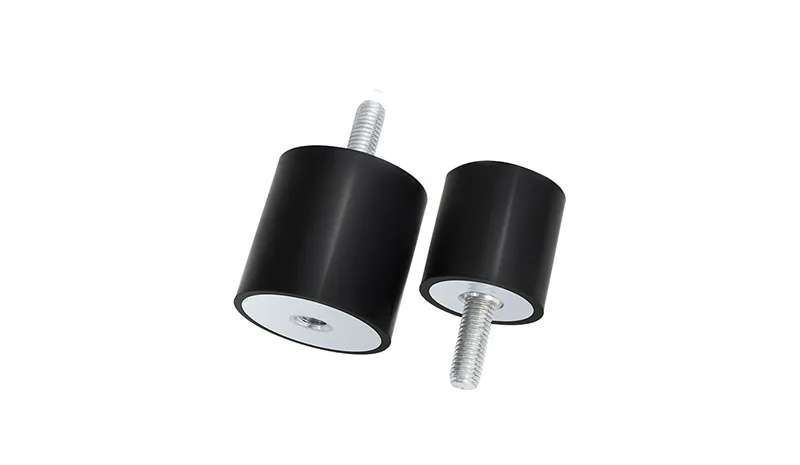
In 2026, suspension engineers and procurement teams are revisiting the rubber versus polyurethane debate with more urgency than before. Heavier EV platforms have increased the static and dynamic loads that bushings must manage. Tighter NVH targets — driven by the near-silent cabin environment that electric drivetrains create — have made harshness complaints more noticeable and more costly to resolve under warranty. And rising warranty pressure has made the "material upgrade" decision more consequential: a switch that improves one performance dimension while degrading another can generate more warranty cost than the original specification it replaced.
The practical question is not which material is stiffer or which has the higher load rating in a laboratory test. It is which material delivers the best balance of ride comfort, real-world durability, and total cost of ownership in the specific joint geometry and operating environment of the application. For the majority of suspension applications — control arm pivots, stabilizer bar mounts, subframe isolators, and engine mount bushings — well-engineered rubber bushings remain the answer that best satisfies all three requirements simultaneously. Understanding why requires a clear-eyed comparison of what each material actually does in a suspension joint, and what the consequences of the wrong choice look like in the field.
The rubber versus polyurethane debate persists because both materials have genuine strengths — and because the conditions under which each material's strengths matter most are different enough that the correct answer depends entirely on the application.
Rubber's primary advantage in suspension applications is its ability to provide vibration isolation and controlled compliance through elastic deformation — without requiring a free-rotating bearing interface. In a control arm pivot bushing, the rubber layer deforms in torsion as the arm moves through its travel, absorbing the energy of the movement and isolating the chassis from the road input simultaneously. This is a single-component solution to two engineering requirements: compliance and damping.
The NVH performance of a correctly specified rubber bushing is difficult to match with polyurethane in the same joint geometry. Rubber's damping coefficient — its ability to absorb and dissipate vibrational energy — is significantly higher than polyurethane's. In the near-silent cabin environment of a 2026 EV platform, this difference is audible. A bushing that transmits road texture into the cabin as a high-frequency buzz is a warranty complaint waiting to happen, and the diagnostic cost of tracing an NVH complaint to a specific bushing is often higher than the cost of the bushing itself.
Rubber also does not require lubrication to function correctly in torsional and shear loading. The elastic deformation mechanism does not generate the sliding friction that causes polyurethane bushings to squeak when the lubricant applied at installation dries out or is washed away. This is not a minor maintenance consideration — it is a customer experience issue that generates dealer visits, goodwill repairs, and negative reviews.
Polyurethane's primary advantages are abrasion resistance, a wider available hardness range, and resistance to certain chemicals and fuels that degrade rubber compounds. In applications where the bushing is subject to high sliding wear — such as a leaf spring eye bushing where the spring slides relative to the bushing under load — polyurethane's abrasion resistance extends service life compared to natural rubber or SBR compounds.
Polyurethane is also available in hardness ranges above Shore A 95 that are difficult to achieve in rubber without compromising other properties, which makes it the correct choice for applications that require very high stiffness in a small package — typically in performance or motorsport applications where ride comfort is not a priority and the driver accepts the NVH trade-off.
The most common mistake in suspension bushing material selection is specifying polyurethane as a "performance upgrade" in a joint geometry that was designed for rubber's elastic compliance. When a rubber bushing is replaced with a polyurethane bushing in a torsion-dominant pivot joint, the higher stiffness of the polyurethane transmits more road input to the chassis, the lower damping coefficient of polyurethane allows more vibration to pass through, and the sliding friction at the bushing interface — if the joint geometry requires any rotation — generates squeak that the original rubber design never produced. The result is a warranty cost that exceeds the cost of the original rubber specification by a significant margin.
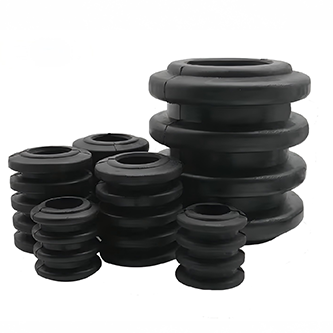
A rubber bushing is a vibration-isolating component that consists of an inner metal sleeve, an outer metal shell, and a rubber layer bonded between them. The rubber layer is the functional element — it absorbs vibration, reduces noise transmission, and allows controlled movement between the inner and outer metal components through elastic deformation rather than sliding contact.
In a suspension pivot application, the rubber layer works primarily in torsion — the inner sleeve rotates relative to the outer shell as the suspension arm moves through its travel, and the rubber layer deforms elastically to accommodate this rotation. The elastic deformation stores energy during the movement and releases it as the suspension returns, providing a progressive spring rate that contributes to the suspension's overall compliance. The damping properties of the rubber dissipate a portion of the energy as heat, reducing the amplitude of vibration that reaches the chassis.
This mechanism — elastic deformation in torsion and shear — is fundamentally different from the sliding contact mechanism of a bearing or a non-bonded polyurethane bushing. Because the rubber layer deforms rather than slides, there is no friction interface that requires lubrication, no wear surface that generates particles, and no stick-slip behavior that produces noise. The bushing functions correctly from the first cycle to the last without any maintenance intervention.
Specifying rubber bushings correctly requires defining the compound family, hardness, temperature range, and media exposure before the design is finalized — because these parameters determine whether the bushing performs as intended throughout its service life, not just in initial testing.
| Compound | Hardness Range (Shore A) | Temperature Range | Best For | Trade-Off |
|---|---|---|---|---|
| NR (Natural Rubber) | 40–90 | -60°C to 80°C | Best overall mechanical properties, low-temperature flexibility, high fatigue resistance | Limited oil and ozone resistance |
| SBR | 40–90 | -50°C to 100°C | Cost-effective general purpose, good abrasion resistance | Lower oil and ozone resistance than specialty compounds |
| BR (Butadiene) | 40–80 | -60°C to 100°C | Excellent low-temperature flexibility, high resilience | Lower oil resistance |
| CR (Neoprene) | 40–90 | -40°C to 120°C | Good weathering, ozone, and moderate oil resistance | Higher cost than NR/SBR |
| NBR (Nitrile) | 40–100 | -30°C to 120°C | Best cost-effective oil and fuel resistance | Lower ozone resistance — requires protection in exposed applications |
| EPDM | 40–90 | -50°C to 150°C | Best weathering, ozone, and heat resistance | Not suitable for oil-immersed applications |
Matching the rubber bushing design to the suspension kinematics of the specific joint is the step that determines whether the bushing delivers its specified performance in the vehicle — or produces the NVH complaints and premature failures that make it a warranty liability.
Step one: define the joint motion. Identify whether the joint is torsion-dominant — a control arm pivot where the arm rotates about the bushing axis — or radial load-dominant — a subframe mount or engine mount where the primary load is perpendicular to the bushing axis. This distinction determines the rubber geometry, the bonding strategy, and the hardness range that will produce the target stiffness curve.
Step two: confirm the package constraints. Define the available outer diameter, inner diameter, and length of the bushing envelope. Confirm the press-fit limits of the housing bore and the inner sleeve, the allowable deflection range at the joint, and the target stiffness curve in the primary and secondary loading directions. These constraints define the design space within which the compound and hardness selection must operate.
Step three: choose the compound family based on the operating environment. If the bushing is in an underhood location with oil splash exposure, NBR is the starting point. If the bushing is in an exposed chassis location with ozone and weathering exposure, EPDM or CR is the starting point. If the bushing is in a low-temperature environment where flexibility at -50°C or below is required, NR or BR is the starting point. SRRP's compound range covers all of these environments with defined temperature and hardness specifications.
Step four: set the hardness and bonding strategy to hit the NVH and durability targets. This step typically requires prototype iterations — the first prototype establishes the baseline stiffness curve and NVH performance, and subsequent iterations adjust the hardness, geometry, or bonding design to move the performance toward the target. Plan for two to three prototype iterations in the development schedule.
Step five: validate in the real environment. Salt spray testing confirms corrosion resistance of the metal components and the bonded interface. Ozone exposure testing confirms that the compound selection is adequate for the weathering environment. Temperature cycling confirms that the rubber maintains its properties across the full operating temperature range. Durability cycling — typically expressed as a number of load cycles at defined amplitude and frequency — confirms that the bonded interface and the rubber layer will survive the service life requirement. Noise testing in the vehicle confirms that the NVH performance meets the target under real driving conditions.
| Suspension Location | Primary Loading | Recommended Compound Starting Point | Key Performance Requirement |
|---|---|---|---|
| Control arm pivot bushing | Torsion | NR or CR depending on ozone exposure | Torsional stiffness curve, fatigue life |
| Stabilizer bar end link | Torsion and radial | CR or EPDM for exposed location | Weathering resistance, compliance |
| Stabilizer bar mount | Radial | CR or EPDM | Radial stiffness, weathering resistance |
| Subframe mount | Radial and axial | NR or CR | Vibration isolation, load capacity |
| Engine mount bushing | Radial and axial | NBR for oil exposure, NR for non-oil | Oil resistance, damping, heat resistance |
| Rear trailing arm bushing | Torsion and radial | NR or CR | Compliance, fatigue life, NVH |
The most significant cost associated with an incorrect bushing material selection is not the cost of the bushing itself — it is the cost of the warranty claim that the incorrect selection generates. An NVH complaint traced to a bushing requires a dealer diagnostic visit, a parts replacement, and a labor claim — typically $150 to $400 per event depending on the vehicle and the market. If the complaint is systemic — affecting a significant percentage of vehicles in a production run — the total warranty cost can exceed the cost of the entire suspension program's bushing content by a factor of ten or more.
Correctly specified custom rubber bushings reduce this risk by matching the compound, hardness, and design to the specific joint geometry and operating environment before production release — rather than discovering the mismatch through warranty data after production has started.
Rubber bushings that work through elastic deformation do not require lubrication to function correctly. This is a practical advantage in both consumer and fleet applications. A consumer who does not maintain a lubrication schedule — which is the majority of consumers — will not experience the squeak that develops when a polyurethane bushing's installation lubricant dries out. A fleet operator who manages hundreds of vehicles does not need to add bushing lubrication to the preventive maintenance schedule. The absence of a lubrication requirement is not a minor convenience — it is a reduction in the failure mode count that the maintenance program must manage.
| Cost Item | Incorrect Material Selection | Correctly Specified Custom Rubber Bushing |
|---|---|---|
| Warranty claim rate | Higher — NVH complaints, squeak, premature failure | Lower — compound and hardness matched to joint and environment |
| Diagnostic cost per claim | High — NVH complaints are difficult to trace | Lower — fewer claims reduce total diagnostic labor |
| Lubrication maintenance cost | Present for polyurethane in sliding contact joints | Absent — elastic deformation requires no lubrication |
| Replacement frequency | Higher if compound is mismatched to environment | Lower — correct compound selection extends service life |
| Customer satisfaction impact | Lower — NVH and squeak complaints generate negative reviews | Higher — correct NVH performance supports brand reputation |
| Development rework cost | Higher — material switch late in program is expensive | Lower — correct specification at prototype stage avoids late changes |
The rubber versus polyurethane debate will continue as long as both materials exist — but for the majority of suspension applications in 2026, the answer that delivers the best combination of ride comfort, real-world durability, and total cost of ownership is a correctly specified custom rubber bushing. Rubber's elastic deformation mechanism provides simultaneous compliance and damping without a sliding contact interface, eliminating the squeak risk and lubrication requirement that polyurethane introduces in torsion-dominant joints. Correct compound selection — NR, NBR, EPDM, CR, or SBR matched to the temperature range, oil exposure, and weathering environment of the specific application — ensures that the performance advantage of rubber is maintained throughout the service life of the vehicle.
The investment in correct specification at the prototype stage — compound selection, hardness tuning, bonding strategy, and validation testing — is the investment that prevents the warranty cost that incorrect specification generates after production starts.
Visit the rubber bushing product page to review the full compound and configuration range, then submit the following details to receive a matched specification and quotation:
| Parameter | What to Provide |
|---|---|
| Work condition | Suspension location (control arm, stabilizer, engine mount), motion type (torsion or radial), oil and ozone exposure, temperature range, corrosion environment |
| Quantity | Prototype quantity and annual production volume, or service and aftermarket volume |
| Size and spec | Drawing or key dimensions (OD, ID, length), sleeve and shell material, bonding requirement, target Shore A hardness |
| Target metrics | Stiffness targets, allowable deflection, NVH goal, durability cycles, noise limits |
| Current problem | Squeak or noise, tearing or cracking, premature wear, harsh ride, tolerance stack-up or press-fit issues |
1. What is a rubber bushing?
A rubber bushing is a vibration-isolating component used to reduce noise, absorb shocks, and control movement between metal parts in vehicle suspension systems and other mechanical applications. It consists of an inner metal sleeve, an outer metal shell, and a rubber layer between them — either bonded to both metal components through vulcanization, or held in place by interference fit. The rubber layer deforms elastically under load, absorbing vibration energy and allowing controlled movement without sliding contact. This elastic deformation mechanism provides both compliance and damping in a single component, without requiring lubrication or generating wear particles. Custom rubber bushings extend this basic design to match the specific compound, hardness, geometry, and bonding strategy to the requirements of the application — including the temperature range, chemical environment, loading direction, and NVH targets of the specific joint.
2. How do rubber bushings compare to polyurethane bushings, and which is the better choice?
Rubber bushings are typically the better choice for comfort-focused suspension applications where NVH performance is a priority, the joint geometry is torsion-dominant, and the operating environment does not require the specific chemical resistance advantages of polyurethane. Rubber's higher damping coefficient absorbs more vibrational energy than polyurethane, its elastic deformation mechanism eliminates the sliding friction that causes polyurethane to squeak when lubrication dries out, and its compliance characteristics can be tuned across a wide range through compound and hardness selection. Polyurethane bushings are the better choice for applications where abrasion resistance is the primary requirement — such as leaf spring eye bushings with high sliding wear — or where very high stiffness in a small package is required for performance applications where ride comfort is not a priority. The correct choice depends on the joint geometry, the primary loading direction, the operating environment, and the customer experience target — not on which material has the higher load rating in a laboratory test.
<p style="margin: 0px 1em 1rem; padding: 0px; color: rgb(31, 35, 40); font-family: -apple-system, BlinkMacSystemFont, "Segoe UI", "Noto Sans", Helvetica, Arial, sans-serif, "Apple Color Emoji", "Segoe UI Emoji"; white